EU LIFE Programme Proposal Context

MODYFLEX

Modular stackable axial-flux drive platform for circular, resource-efficient industrial applications. One architecture scales from low-power single-use needs to multi-motor industrial duty without redesign.

42 Months Project duration
5 Partners Cross-border consortium
TRL 5 -> 7 During project lifecycle
>80% Shared parts commonality
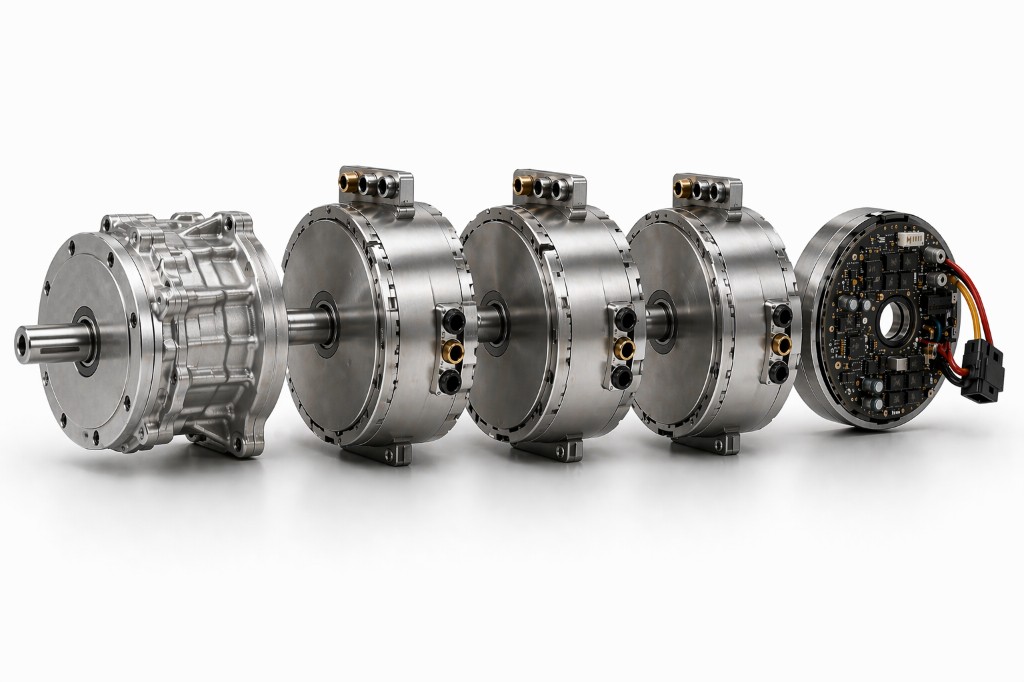
MODYFLEX concept render

Problem in Current Motor Landscape

Scale and Inefficiency

  • The EU installed motor base is vast, with strong concentration in sub-10 kW use cases.
  • More than 30% of installed motors are oversized for actual duty.
  • Oversizing can waste 15-40% of input energy as heat.

Fragmentation and Circularity Gap

  • Sector-specific motor-gearbox combinations create high SKU complexity.
  • Typical sectors carry 50-100 dedicated SKUs, increasing tooling and logistics burden.
  • Replace-rather-than-repair practices increase e-waste and embedded energy loss.

MODYFLEX Concept

Universal Building Block

A single air-core axial-flux unit acts as the base module. Stacking 1 to 5 units scales continuous output from around 1 kW to above 10 kW.

  • 48V and 100V configurations within one product logic.
  • Linear stack scaling supports broader application fit with fewer custom designs.

Common Platform Envelope

  • Motors, ESC-2/ESC-5 controllers, and reducers share a 150-160 mm envelope.
  • Reducer range 1:3 to 1:50 in a consistent bolt-on architecture.
  • Integrated encoder and closed-loop FOC for precise control across variants.

High Value Proposition for LIFE Reviewers

Technical and Operational Value

  • Standardized stackable architecture reduces redesign cycles across sectors.
  • Platform reuse enables faster deployment in marine, industrial, and agriculture contexts.
  • Tool-free reducer swapping supports adaptable field operation.

Environmental and Circular Value

  • Rare-earth material demand reduced by 30-50% per deployment context.
  • Hydraulic substitution removes oil leakage risk in sensitive marine operations.
  • High parts commonality (>80%) supports repairability and life-extension pathways.

Evidence and Expected Impact

120-180 MWh/yr Expected annual energy savings during project phase
2,500-5,000 MWh/yr Expected annual savings 5 years post-project
45-75 tCO2/yr Expected annual CO2 avoided during project phase
950-2,000 tCO2/yr Expected annual CO2 avoided 5 years post-project
500-1,000 L/yr Hydraulic oil eliminated during project deployments
15,000-40,000 L/yr Hydraulic oil elimination potential post-project
Projected energy and CO2 impact comparison chart
Projected environmental impact trajectory: during project and post-project phases.
Cross-sector replication opportunities for MODYFLEX
Cross-sector applicability: marine, industrial, agriculture, e-mobility, and robotics.

Implementation and Replication Path

M1-M18 | R&D Validation
Bench validation of single module and integrated stack + reducer configurations.
M12-M36 | Integration and Demonstration
Deploy pilots in Norway and Bulgaria, measure operational performance against baseline.
M24-M42 | Industrialization
Complete pre-compliance, final replication toolkit, and roadmap toward TRL 9.